
17th June - FOMC Day
The Memorandum of Understanding (MOU) is still due to be signed in Switzerland on Friday. The one notable news item on the deal is that it will allow oil to be exported from Tehran as soon as the deal is signed, giving Iran extra incentive to sign and putting some immediate downward pressure on oil prices. The crack in the armour for optimism around the deal seems to be Lebanon. Israeli officials yesterday said troops would remain in Lebanon and stated 'Trump's agreement does not bind us.' Iran's position had always been that a condition of longer-term peace would be that Israel withdraw from Lebanon, and yesterday they gave guarantees that a nuclear deal would not be signed over the coming weeks unless Israel withdraws. While in theory this should not stop a deal from being signed on Friday, it is a risk to be factored into the wider picture in the Middle East.
Forex
Without a doubt, the biggest news event of the day is the FOMC release and the forward guidance surrounding it. This is the first meeting chaired by Kevin Warsh, and this will be the first time he is the one to give forward guidance. Warsh was appointed by Trump, who has repeatedly called for interest rates to be lowered. The decision, however, is one made by committee and not by the individual, so Warsh does not hold the power to lower rates by himself. Indeed, in some more recent comments, he has intimated that he does not believe rates should be lowered while inflation is high. He has also said that the AI revolution would increase productivity and allow rates to be lowered in the long term, and has become more dovish overall since his first stint with the FOMC in 2008. The market consensus is that he will be a little hawkish in the short term, to then allow him to be more dovish in the long term. It is worth noting that Warsh is known to dislike future guidance, so we may see a non-committal press conference later and little forward guidance for the markets to digest.
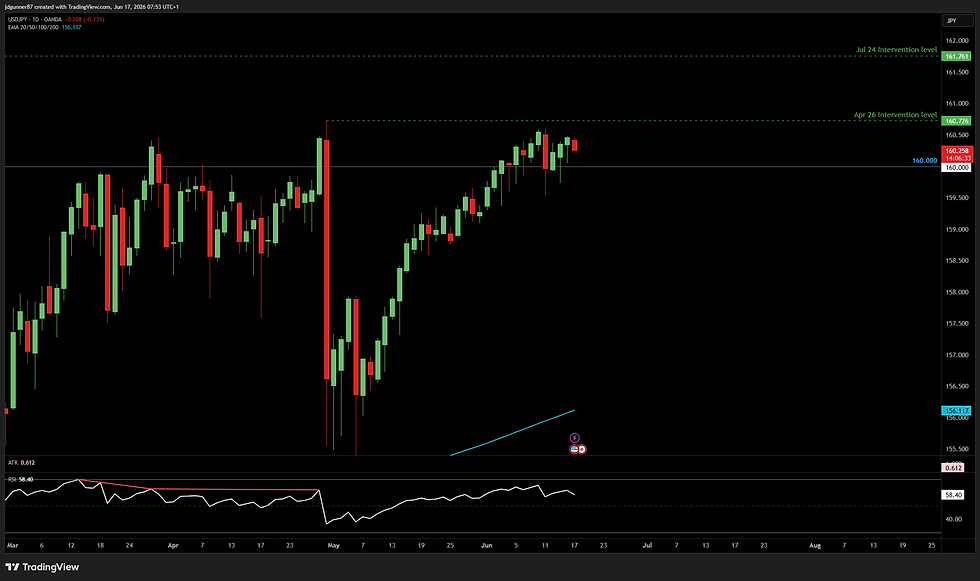
The markets were essentially in wait-and-see mode yesterday ahead of the FOMC action later today, with most currencies relatively stable on the day. We saw a minor selloff in USD, but the DXY was only down 0.1% on the day and so not a significant move. The USD/JPY remains elevated above 160.000, meaning the FOMC decision could be key for taking the pair past the BoJ's desired ceiling for the pair. If we see an unexpected hike (unlikely as markets are predicting there is a 98% chance of a hold) or hawkish future guidance, we could see the BoJ feel the need to intervene manually to keep the pair suppressed. It will be an interesting dynamic to watch out for as part of the wider picture going into the day.
The only other currency to have a notable move yesterday was the CHF, which was broadly strong across its basket. We would normally have expected the safe-haven CHF to sell off after a peace deal announcement, so it was interesting to see CHF perform well on the day. The answer to this may, interestingly, be exactly because it is a safe-haven currency. With the FOMC coming up today and uncertainty on how new Chairman Warsh will approach the event, capital may have flowed into the CHF to reduce the risk associated with holding USD ahead of such an event. The safe-haven nature of CHF may have temporarily shielded it from losing safe-haven demand after the peace deal was announced.

Indices
We saw another fascinating move yesterday in the indices. Tuesday was, as one analyst put it, "the opposite of Monday". We saw a continued move long in the Dow Jones and a pullback in S&P 500 and Nasdaq, again reversing the flow of capital away from growth stocks and back into value stocks. The positioning here is likely due to the FOMC uncertainty, so it could be reversed yet again over the remainder of the week if we see a dovish outcome.
The concern remains the volatile nature of the indices under the bonnet. Yesterday saw the tech sector stocks fall while almost everything else rose, the opposite of Monday when the tech sector was the only real winner. Markets at the moment are being driven by indecision rather than conviction in either direction.
The indices could go either way today depending on the FOMC guidance. Dovish language could see all three US indices break all-time highs, while hawkish guidance could see a pullback that is then extended by a 'sell the news' selloff after the Iran deal is signed on Friday. It may be worth staying out of the market until after the FOMC to have a better idea of the expected market direction.

Precious Metals
Yesterday saw some further support for both gold and silver, as oil prices continued to fall. The rate-hike concerns surrounding the metals have receded, continuing to overwhelm the loss of safe-haven demand from the end of the war. Gold has risen to $4,330, a 7.6% increase on its low and on the way back to the key $4,500 level. Silver has risen to its key level of $70 already, an increase of 13.9% from its own lows.
Once again, the FOMC meeting and guidance are key for metals today. They have been driven by interest rate concerns since the start of the war, and that will not change overnight. Dovish guidance will be positive for metals, while hawkish guidance will move the metals lower.

Today's Key Market Drivers
FOMC - The rate decision itself should be a non-event with a rate hold fully priced in. A surprise here could cause chaos. The more interesting part will be Fed Chair Warsh's press conference and any forward guidance given for the path of future decisions.
UK CPI Figures - Due to be released this morning, they will have a keen impact on the BoE's future interest rate decisions.
US Retail Sales - This will be overshadowed by the FOMC decision; it will nonetheless help us get a better idea of the health of the US economy as a whole.
Iran - Any developments that could jeopardize the deal to be signed on Friday would be hugely impactful.
Comments