
8th June - Hikes And Escalation
Updated: Jun 9
Geopolitics
The peace negotiations in Iran took a clear step back over the weekend, as we saw new strikes from both the US and Iran, Israel ordering troops deeper into Lebanon and - possibly most importantly - Hezbollah rejecting the US-brokered deal with Israel. As Iran has consistently stated there also needs to be a ceasefire in Lebanon to end the war, the rejection undermines the peace efforts overall significantly.
On top of the escalations, Iran seems to be expanding its demands and is now demanding Israel halt attacks in Gaza and withdraw from occupied areas in Lebanon completely. It has also threatened to block the Strait of Hormuz completely and extend this to the Bab el-Mandeb Strait (between the Red Sea and the Gulf of Aden). This is a less busy waterway, but will nonetheless exacerbate the already significant oil supply issues globally.
Oil has jumped this morning, with US oil up close to 5% compared to Friday's close. The markets are now having to stomach what had been largely ignored, that a deal may not be struck imminently and that there could be some way to go before the war is ended.

Forex
On top of the escalations in Iran, the largest event on Friday by far was the NFP report from the USA, which massively beat expectations. We had a prediction of 85k but saw a figure more than double at 172k and also saw an upward revision of the previous month's figures. This sent a shockwave through the markets; the previous narrative of a weaker job market in the US was shattered, and the FOMC rate hike expectations for the remainder of the year increased significantly. Before Friday, the FOMC would have been more hesitant to increase interest rates to tackle inflation, as it would negatively affect the jobs market and dampen demand in the economy overall. With Friday's strong jobs numbers, the FOMC now does not need to be as concerned, as it is able to raise rates against an already strong jobs market.
We saw a significant move in the USD because of this; the DXY jumped on Friday to over 100.000 and broke out of the short-term range it was in. The move was helped not just by the NFP figure but also by the renewed safe-haven bid from escalations in Iran, meaning the USD now had a twin tailwind to give it strength as we head into this week. Unless we see some form of de-escalation and/or a deal signed with Iran, all signs point to further USD strength as we move through the week.

The USD/JPY continues to be a fascinating market. We are now comfortably into the 160s and have not yet seen an intervention from the BoJ. The fundamentals at the moment are pointing towards further rises in the pair (interest rate differentials, USD safe-haven demand, Japanese sensitivity to the energy shock), meaning we are likely to see continued pressure on the BoJ as the pair moves towards 161.000. The question will remain the same for this week - at what level will the BoJ intervene and how aggressive will the intervention be? We have not heard any comments from the BoJ that they are abandoning their stance that the 160.000 level is the highest they are willing to go, so an intervention seems like it could be likely at some point this week.

The EUR, GBP, and CHF all seem to be in a holding pattern at the moment, amidst the chaos around them. Each of these currencies at present seems to be moving based on the currency they are paired with, as opposed to being the catalyst for a move themselves. The EUR does have some rate hike support going into this week's ECB meeting, while there may be some minor CHF safe-haven demand for capital that was not moved into the USD. The GBP seems to have moved away from the political uncertainty surrounding it over the past few weeks, but there is no real independent catalyst for the GBP, so for the time being, it continues to dance to the tune of the currencies it is paired with.
As expected, the commodity currencies are moving based on the commodities they are affected by. The oil price spike has given support to the CAD, while the fall in the price of precious metals has caused a fall in the price of the AUD & NZD. This will continue to be the case until we see a resolution in Iran or an independent catalyst for one of these countries outside of the commodities themselves.

Indices
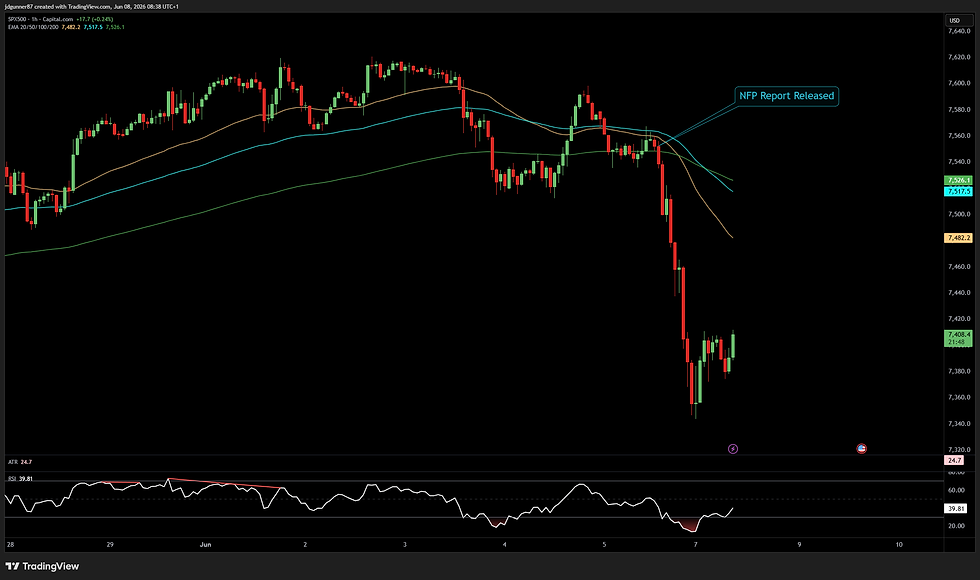
Indices were one of the largest stories on Friday, with the major US indices falling like a stone after the release of the NFP report, and then hit again over the weekend by news from Iran. The move as a result of the NFP report was stark; the Nasdaq closed the day at -5.2%, the S&P 500 at -2.93%, and the Dow at -1.65%. Often, positive jobs news is good for indices, as it indicates a strong jobs market and thus a resilient economy. However, in this case, the effect was different. The strong jobs number this time took away any possibilities of a rate cut and increased the likelihood of a rate hike in the near future. Rate hikes not only make risky stock indices less attractive for capital looking for safe returns, but they also impact the stocks themselves.
Part of a stock's value is the present value of its expected future earnings, discounted against the expected treasury rate for when those earnings are realized. A stock is valuable if it earns more than can be earned by passively investing in government bonds. If interest rates are higher, then the expected earnings for a company are less when interest rates are removed, meaning stocks being traded for their future earnings are more heavily impacted by rate hikes. The companies most traded based on expected future earnings are tech and AI stocks, which are also the stocks that have been driving the indices north over the past weeks and months largely by themselves. As a result, the expected interest rate hikes, thanks to the NFP report, have had a significant impact on the indices as a whole and may continue to do so as we move through the week.
Precious Metals
We saw the expected result from the NFP report for precious metals; an increase in the likelihood of rate hikes caused the price of Gold and Silver to collapse on Friday. Gold fell 3.27% on the day, and Silver 8.33%. This rate-hike-caused drop is now comfortably the dominant market force in the precious metals market. We may see some pushback today thanks to the escalation in the Middle East and a reintroduction of some safe-haven demand (JP Morgan noted there could be a risk premium jump of 5-10% on the news over the weekend), but to do that, we would have to see a reversal of the trend we have seen over the past few weeks, where any safe-haven demand has been overshadowed by the lack of demand due to rate-hike risks. This week will be interesting to see if this dynamic changes at all, or whether precious metals continue to fall as the week goes on.

This Week's Key Market Drivers
Iran - Has the deal genuinely stalled, or is each side bluffing and posturing to get a better outcome for themselves? We will hear a number of rumors and reports over the week that will move the market as we eventually get closer to a final outcome.
USD/JPY Intervention Risks - Will there be an intervention in the JPY currency pairs? If so, where will it be, and how much will they intervene? We will not know for sure until it happens.
USD CPI Reports, Wed 1:30 pm UK time - The Core CPI tends to be the FOMC's preferred method to measure inflation, so any surprises in this release will have a similar impact to the NFP on Friday, so it will be a key data release to monitor.
USD PPI Reports, Thu 1:30 pm UK time - This will have slightly less impact than the CPI figures, but will still have an effect, and any surprise will move the market.
CAD BoC Rate Decision, Wed 2:45 pm UK time - The Canadian interest rate decision should only affect the CAD itself, but a surprising decision or unexpected guidance will move CAD markets significantly.
ECB Rate Decision, Thu 1:15 pm UK time - Another important rate decision, the ECB is expected to hike rates. The questions will be by how much and how many times this year will they hike?
GBP GDP Figures, Fri 7:00 am UK time - A key figure for the GBP markets, this will shape the BoE's interest rate decisions moving forward.
Comments