
3rd August - Yen Demand Continues
Geopolitically, the weekend was entered into with significant uncertainty, which has not really changed as we come out of the weekend. There were no new strikes in Iran on Thursday or Friday by the US, which continued over the weekend. The fragility of the situation, however, was shown by news that an oil tanker was hit by an unknown projectile off the coast of Oman, with the attacker unclear. Additionally, in the wider region, Kuwait has claimed to have intercepted drones and missiles from Iran. The situation between the US and Iran remains tense but cooled, while aggression in the wider region still remains active.
Yesterday, Trump suggested while onboard Air Force One that new talks would begin today between the two nations, but this has not been confirmed by Iran, and there have been no details on locations or attendees. Trump has made a number of similar comments in the past, so it is difficult to know if these are real developments or just wishful thinking from the President. The oil markets, however, seem to be reacting positively to the news, as Brent Crude is down 8% since Friday's close at $87.12, while US Oil is down 8.6% and is at $77.64, with Brent now a full 15% lower than its high on the 23rd of July. With both the Strait of Hormuz and the Bab al-Mandab Strait still not fully clear for shipping, there is a natural floor for oil prices, but oil seems to be moving in the right direction overall and will only continue that way if there are indeed talks today between the US and Iran.

Forex
The main story at the end of last week was the coordinated intervention in the JPY from the BoJ, as we have tracked as a possibility for months now. This story has followed through into the beginning of this week, as the USD/JPY has continued to fall and is sitting this morning at 156.750, having reached as low as 155.250 overnight. That amounts to a drop of over 5%, a huge figure in forex terms. The move was begun by intervention but seems to be following through with market demand, thanks to weak US data releases over the past few weeks as well as last week's FOMC meeting leaving parts of the market doubting the Fed's credibility in combating inflation.
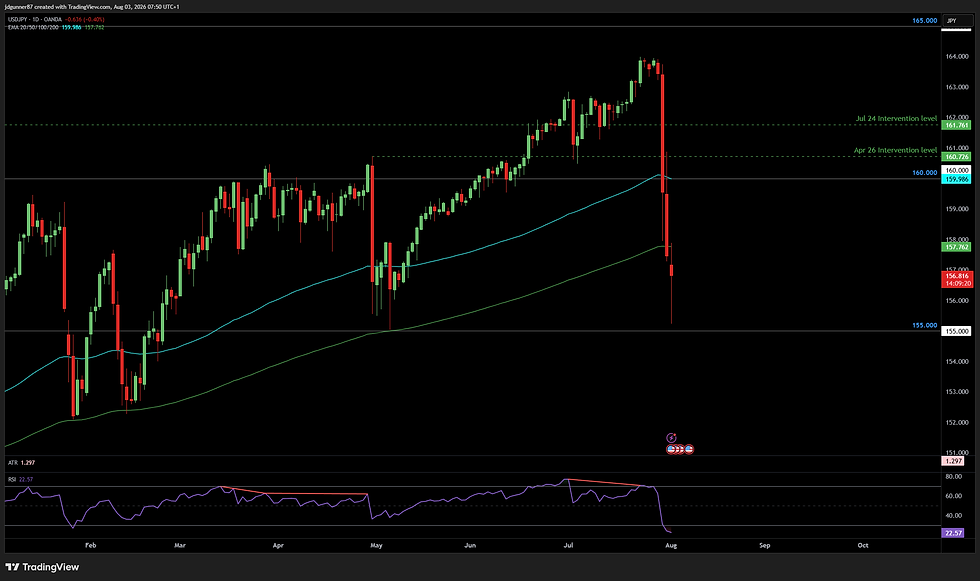
While there may be some pullback in the short term as the market has moved so far so fast, I would not be surprised to see this pair fall further in the medium term, as the fundamentals are currently stacked against the USD and the BoJ has recently warned inflation will exceed their target, implying they will need to take a more hawkish stance moving forward.
Outside of the USD/JPY, the dollar in general has weakened significantly since the FOMC meeting last Wednesday, with the DXY now back below 100.000 at 99.617 at the time of writing. There has been a significant change in sentiment around the currency, with markets now repricing the USD based on reduced Fed credibility on top of weak economic data over the past few weeks. In a short space of time, we have gone from the USD being stronger than everything, to the USD losing ground to everything. One point of note on this, however, is that the long-end yields for the US are surging, which is normally good for the USD. The US 10y yield, for example, closed on Friday at 4.71%, its highest close since January 2025, while the 30y yield is at a multi-decade high of 5.24%.
I wonder whether this could be, similar to the UK earlier in the year, an example of when high yields are a signal of a loss of confidence in the economy as a whole and is actually negative for the currency. Normally, higher yields would attract more investment and so would increase the demand for the currency used to buy those bonds, thus strengthening the currency. However, if the economy is weak and no one is willing to invest there, that lack of demand reduces the price of a bond and so increases its yield. This increase in yield does not bring increased currency demand, as it is the USD weakness that is keeping people away from investing in US bonds to begin with. This will be an interesting wrinkle to monitor this week as we approach Friday's NFP release, as this could be a sign that the USD could be in for a longer-term struggle.

Indices
Friday saw a small follow-through on Thursday's huge rally, with all three major US indices having a green day. All three have also gapped higher this morning after positive news over the weekend with regards to the war in Iran, though as mentioned, this is a fragile situation that could deteriorate just as easily as it could improve.

The two standout results on Friday were Apple and Amazon, with Apple falling over 9% whilst Amazon rose over 15%. Apple fell despite beating earnings, as its Q4 guidance was worse than expected, meaning this was yet another example of a 'priced-for-perfection' pullback, where anything but the best results expected lead to a drop in the stock. It is worth noting that even the mega-cap least exposed to AI capex got sold on a guidance miss, meaning this phenomenon is not just restricted to negative reactions to AI capex guidance.
On the other hand, Amazon jumped on 37% growth in its AWS business. The spender-versus-supplier and show-me-the-return themes held right through this earnings week: Amazon rewarded for cloud services growth, Apple punished for a soft outlook, Microsoft (up 19% on the week) the biggest winner of all. Microsoft's record week is the clearest statement of what the market wants, it needs to see returns now and is no longer rewarding companies for AI investment for the future.
The monthly picture reflects the sobering backdrop: the Nasdaq fell 3.2% in July, the S&P was roughly flat (-0.13%), and the Dow rose 0.32%. This month was as good of an example as you can find that tech stocks are struggling whilst value stocks are performing well. The signs are there that the balloon is deflating rather than popping, we will see in August if this trend continues.
Precious Metals
Metals continue to struggle, even with the fall in oil over the second half of the week. We have seen the beginnings of a catalyst, with oil prices falling and inflation lower than expected, but we are not yet out of the rate-hike cycle, and there are still hikes expected later this year. Metals are currently in a range and are stuck between lower oil and hawkish central banks, with currently no indication that this will change in the short term. The highs and lows of the respective ranges for both gold and silver are looking more and more like the key levels to watch out for; a catalyst either way could lead to a medium-term move in that direction.

As I have said on a number of occasions, once we are through this rate-hike cycle and rates begin to come back down, metals have the potential for a strong push up, but until then there seem to be too many factors working against them for a short-term bullish outlook.
This Week's Market Drivers
Iran - The importance of the conflicts in the Middle East has not changed; updates from the region will be as important this week as any news event.
US ISM Manufacturing PMI – Monday 4th (3pm UK) – The first timely read on the US economy since the soft Q2 GDP, and a key test of whether the manufacturing side is genuinely cooling into a Fed that has just lost credibility.
Swiss CPI – Tuesday 5th (7:30am UK) – The main inflation print for a franc that has been trapped between its safe-haven role and the SNB's zero rate, so any surprise will move the CHF crosses.
US JOLTS Job Openings – Tuesday 5th (3pm UK) – The first of the week's labor releases ahead of Friday's payrolls, and an early clue as to whether the jobs market is loosening in the way the Fed's critics fear.
NZD Unemployment Rate – Tuesday 5th (11:45pm UK) – The key quarterly labor data for the Kiwi, and important context for the RBNZ after its recent hawkish hike.
US ADP Non-Farm Employment Change – Wednesday 6th (1:15pm UK) – The private payrolls number that acts as the warm-up act to Friday's NFP, and the first hint at how strong the official jobs print might be.
Canadian Employment & Unemployment Rate – Friday 8th (1:30pm UK) – The main event for the Canadian dollar, landing at the same time as the US jobs report, so the two will be read side by side.
US Non-Farm Payrolls & Unemployment Rate – Friday 8th (1:30pm UK) – The big one, and the single most important release of the week. With the market convinced the Fed is behind the curve, a soft print would pile pressure on the dollar, while a strong number muddies the picture entirely.
Comments