
24th June - The AI Selloff Begins?
The most significant news of the day yesterday was the significant AI selloff in stock markets that began in Korea. In terms of geopolitics, the US and Iran continue to negotiate, though the tone yesterday was a little more combative, with Iran saying the Strait of Hormuz "will never return to its previous state before the war." Markets are seeing this as just another negotiating tactic, however, and the rhetoric yesterday did not cause significant moves. The market remains focused on the FOMC and the AI/Tech sector.
Forex
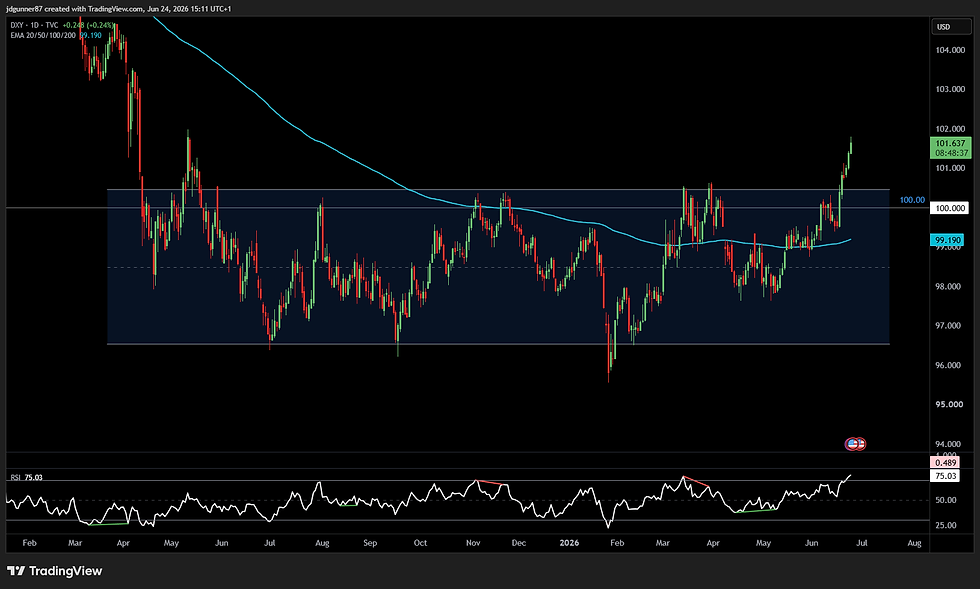
The USD continued its strength yesterday, with the DXY now in the high 101s and pushing towards the 102.000 mark. The DXY seems to have broken out of a channel it has been stuck in since May 2025, with all signs pointing towards continued strength unless we see a significant change in rhetoric around the FOMC or unexpected data releases.
The USD/JPY continues to be in focus after the suspected intervention on Monday. The pair has now moved back up to 161.700, just shy of the 161.930 level where the BoJ intervened this week. The same questions remain around the pair as they have for weeks. Depending on the speed of movement today, we may see this story come to a crescendo tomorrow with the US PCE print. A hawkish number would force the BoJ's hand to either intervene significantly or to give up their position, while a dovish number will do their work for them. Whatever the outcome, it will be fascinating to watch. In terms of trading, the potential volatility and uncertainty mean it will be a very risky play to trade around the event. You would need to make sure your risk is very tightly managed to avoid the risk of extended spreads during the event.

Outside of the USD, the major movers yesterday were the AUD and NZD, with both showing significant weakness both yesterday and into today. Yesterday's weakness seemed to be linked to a number of factors, with one being that the continued weakness in precious metals puts downward pressure on economies such as Australia that mine them. We also saw a risk-off sentiment in the market tied to the AI/tech story, again putting pressure on a risk-on currency such as the AUD. We also saw some capital move out of the AUD in advance of the overnight CPI print, again looking to remove risk from what could have been a volatile news event. The NZD weakness seemed to be tied to the fate of the AUD; the New Zealand economy is heavily linked to the Australian economy, so bad news for the AUD tends to be bad news for the NZD.
The CPI prints for the AUD saw lower than expected readings for CPI m/m and y/y (-0.7% compared to -0.4% for m/m and 4% compared to 4.3% for y/y), but also saw a hotter than expected Trimmed Mean CPI m/m (0.4% compared to 0.3%). Whilst inflation overall was less than expected, the core inflation statistics were more than expected, the implication being that whilst oil prices removed some of the inflation pressure for the more volatile commodities, the underlying inflation problem caused by the energy shock has not gone away; if anything, in Australia it was more sticky than expected. The immediate move from these figures was muted as the results were mixed overall, but the long-term consequence could see some more hawkish positioning from the RBA and some strength coming back into the struggling AUD. The AUD/USD pair is crossing the 200-day EMA as we speak and is due to hit a previous level of support on the daily chart, so we could see some technical support in the short term, but we would need comments from the RBA to really give the currency the support it needs in the longer term.

Outside of the USD and AUD, the other major currencies had steady days. The GBP continued to digest the Starmer resignation and is waiting to see the timeline for the handover. The CAD continues to struggle against the lowering oil prices, while the EUR and CHF showed no real direction on the day.
Indices
Yesterday, we saw significant moves in the indices, with further evidence that we may be seeing a larger move away from AI/tech and into value stocks. The Dow was largely even on the day, while the S&P 500 lost 1.3% and the Nasdaq lost 3% on the day. The largest moves were from Asia, where the South Korean Kospi index fell a full 10% at one point and saw circuit breakers tripped twice, with the Japanese Nikkei also falling 5.25% on the day overall. The move in Korea was caused by regulatory signals suggesting the chip rally was overheated and saw Samsung and SK Hynix both fall 12% on the day. In the US, we then saw similar moves - Sandisk fell 11%, Micron fell 13%, AMD fell 5.8%, and Nvidia fell 4.2%, to name just a few.
The key point here is that the falls were exclusively in AI-heavy stocks; companies such as IBM actually rose on the day, and as mentioned, the Dow was even. This is a perfect example of what we have spoken about for a number of days. With the Iran war catalyst now largely in the rear-view, will markets continue to throw money at AI stocks, or will the concerns about huge investment for no short-term returns catch up to them? The past week or so of broadly negative days for the tech-heavy S&P and Nasdaq seems to be showing us that it is the latter. It is important to note as well that this is not looking to be a violent short-term move, a popping of the balloon; it seems to be a more measured move away from AI, a slower deflation of the balloon, so to speak. The next few weeks will be interesting to see if this trend continues.

Precious Metals
Gold and silver continue to fall as signs still point to higher inflation for longer. We are seeing lower oil prices, which should be good for metals as it will reduce inflation in theory, but we are still seeing higher US Treasury yields at the moment. The US 2-year yield is still close to multi-year highs, which implies that the market still thinks that inflation will be sticky and the FOMC's hawkish stance will stay in place for the time being.
This means the PCE print tomorrow is crucial for the metals' short-term future; lower than expected and metals will jump, higher than expected and metals will collapse. Longer term, there is still a case for precious metals to recover, but in the short term, it is a very uncertain picture.

Today's Market Drivers
US Core PCE Preparation - Tomorrow's PCE figure is the largest news event of the week, with markets likely preparing themselves for the figure. The likelihood is we will see a risk-off sentiment overall in advance of the market-moving release.
Micron earnings (after market close) - This could continue to push capital away from AI should earnings be weak, or pump more air into the AI bubble should earnings be strong.
Comments