
1st June - Still Waiting
Geopolitics
There was no deal signed over the weekend, despite the news we had last week that an MoU had been reached. Trump had a meeting in the Situation Room of the White House on Friday, but came out of it without announcing a final decision despite hinting otherwise beforehand. On Truth Social, he then demanded that Iran must agree to never have a nuclear weapon, as well as that the Strait of Hormuz must be immediately opened to unrestricted traffic.
The markets have largely priced in that a deal is effectively done, but the comments from Trump imply there is still some disagreement on some of the key issues up for discussion - the nuclear issue and the Strait. This could just be further posturing from Trump as the finer details are negotiated, or it could be a sign that a deal is not as close as the market thinks. The asymmetric risk remains in play today; a deal will move the market somewhat, but escalation will move the market significantly.
It is also important to note that even if a deal is agreed upon today, there has already been significant damage done to the world's energy infrastructure; reportedly, more than 1.2 billion barrels of oil have been disrupted since the start of the war. It will take significant time to return to normal no matter how quickly a deal is struck.
Forex
The USD drifted lower through Friday and into this morning as optimism around an Iran deal continued to unwind the risk-off demand for the currency. The DXY fell below 99.000 once again, a level it has been floating just above for the past few weeks. The fact that the deal optimism has not materially pushed the DXY below the 99.000 level shows clearly how the deal being reached has largely been priced in. If the news of a deal was a shock to the market, we would have seen a significant move lower. Moving forward, unless there is a significant escalation in tensions, we can expect to see the normal economic data return to being the main market drivers for Forex.

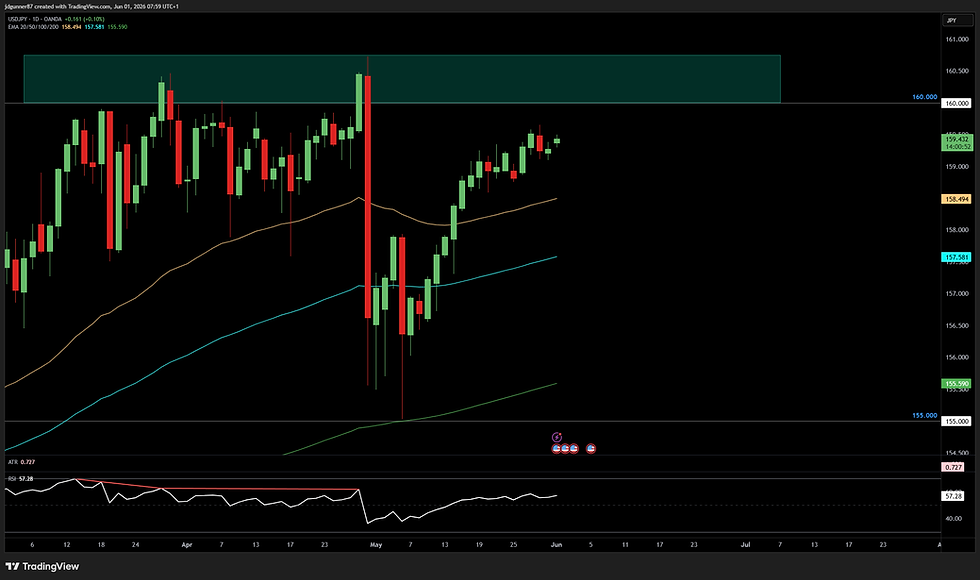
The JPY has continued to struggle over the past week or so. The USD/JPY chart has continued its slow creep towards 160.000, the key decision point for the BoJ. With the potential deal not showing as anything more than a minor hiccup on the road to 160, it seems inevitable that the BoJ will once again be forced to consider intervention in the pair to keep a lid on the JPY's weakness. At that point, we could have another opportunity where the risk profile is asymmetric. If the BoJ does nothing, the pair could continue to drift higher and risk could be managed. If they do intervene, we could see profits returned from a short trade in a matter of hours. Once we hit the 160 level, it will be a pair the entire market will be looking at.
The EUR and GBP remained largely level over the weekend, with their basket being moved more by the currencies they are paired with rather than the EUR and GBP themselves. In the long term, the EUR should see support from the ECB's rate-hike repricing, while the GBP is still struggling with political uncertainty around Keir Starmer's position as PM.
In terms of commodity currencies, the CAD continued to drift as oil prices continued to fall, while the AUD gained ground thanks to increases in precious metal prices, with gold in particular performing well on Friday. The NZD continued its strength on the back of the RBNZ's actions last week, a move that is set to continue to give the NZD strength in both the short and long term.

Indices
Friday saw fresh highs again, with new records set in the S&P 500, Nasdaq, and Nikkei. The S&P has now seen nine straight weeks of positive gains, its longest winning streak since May 2023. The markets were buoyed by the usual suspects, a general positivity that a deal will be struck in Iran, as well as the AI rally showing no signs of slowing down.
The warnings, however, remain the same: there is a limited upside on the announcement of a deal, but significant downside should there be escalation in Iran. I would not be trying to short the market at the moment as it could continue to grind higher for a while, but buying at all-time highs during a record run gives a risk-to-return ratio that is absolutely not in your favour. All we can do at the moment is sit on the sidelines and marvel at how much further the markets could go.

Precious Metals
Gold saw further support on Friday, while Silver was slightly down overall. Both metals are receiving some support from lower oil prices relieving rate-hike tensions a little, but both remain in risky territory. They will both suffer from a removal of what little safe-haven demand they did receive due to the war, whilst in the long term both are still affected by the rate hike narrative that the extended energy shock has provided.
As we have seen with recent RBNZ comments, central banks are now leaning towards rate hikes instead of cuts, which will reduce the demand for the non-yielding metals. Consequentially, while Gold has seen some support over the past few days, in the longer term I feel we are more likely to see further moves lower before we see any sustained moves higher. Silver is under the same pressure, but its uses in technology should continue to see a floor in its price even as Gold falls.

This Week's Market Drivers
Peace in Iran - This will continue to dominate headlines for the week and will be the main talking point. Will a deal be reached, or will we continue to see differing headlines coming from either side as negotiations continue?
Oil Prices - Largely influenced by the war in Iran, the continued fall in oil prices will be keenly watched by central banks as they grapple with whether rate hikes are needed to combat inflation.
Central Bank Speakers - We have a number of central banks speaking this week, with almost all of the largest currencies due to be discussed by their central bank at some point in the week. Any unexpected language is what to look out for that could change interest rate expectations.
US NFP Figures, Friday 1:30 pm UK time - The blockbuster data release of the week, this will give us further information on the US economy's health and will play a role in what figure we can expect at the next FOMC meeting, which will be the first under new chairman Warsh.
Comments