
17th August - Hardened Rhetoric On An Otherwise Quiet Weekend
The weekend passed without escalation, outside of comments made by both Iran and the US towards each other and another ship attacked in the Strait of Hormuz.
Iran and Oman have not yet finalized their agreement on managing the Strait, damaging some of the optimism at the start of the month. Additionally, there has been escalated rhetoric from the US over the weekend - Secretary Bessent said Washington would impose "unprecedented economic measures" on Iran while maintaining the naval blockade, with further announcements expected this week, while more fancifully Trump said in a speech this week that at the end of the war he would be announcing the Strait of Hormuz as a US territory. On the Iranian side, another vessel from Abu Dhabi was struck in the Strait on Friday, which the UAE called a flagrant violation of international law.
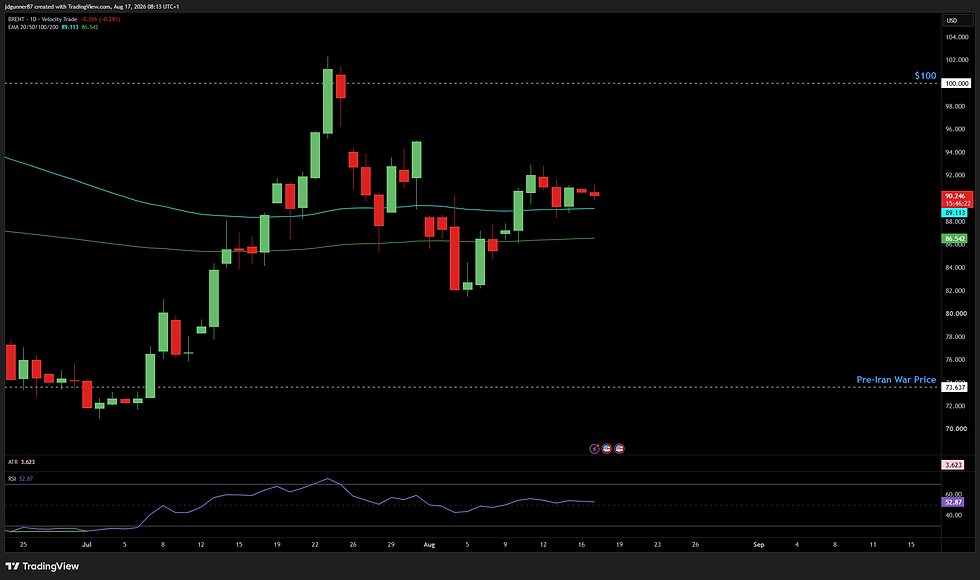
Oil was relatively stable on Friday and has remained so this morning, with Brent hovering around $90 and US Oil around $81. The momentum is still for oil prices to rise, with comments from the IEA (International Energy Agency) not boding well. They stated that we currently have the largest global supply deficit of the last 5 years, implying that unless something changes with the Strait of Hormuz, then oil prices are likely to stay higher for longer.
Forex
Friday saw yet more negative economic data from the US, with retail sales -0.6% against an expected 0.1% and UoM Consumer Sentiment 51.0 against an expected 54.7. While this is not the high-impact event in the vein of CPI or NFP, this nonetheless adds to the negative sentiment around USD and reignites concerns around stagflation. As a consequence, USD fell further on Friday, with the DXY falling below 100.000 and continuing to fall this morning. At the moment, there doesn't seem to be too much going right for the USD, and with no major US news releases this week, it will need some form of geopolitical change to give any support back to the USD. This could well be a difficult week for USD bulls.

The CAD continued to show strength on Friday, once again outperforming oil on the day. This is one to continue watching, as mentioned last week, CAD has been very closely linked to oil since the start of the war, so any change in this relationship would be very interesting to see. It may be that the CAD market is front-running the oil market a little, for the reasons we have already mentioned. There is an expectation that oil prices may continue to rise, so there is every chance that investors are putting money into CAD in advance of an expected rise in oil, rather than because of it.

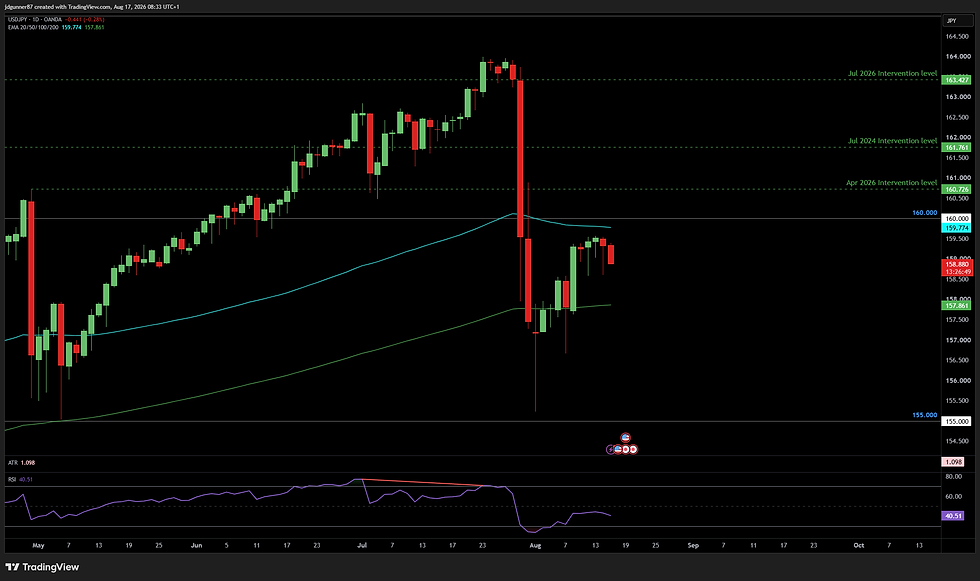
After the interventions that moved markets at the end of July, the JPY has seen a slow but steady fall against all other pairs this month, which continued throughout most of last week. We are still nowhere near intervention territory again, but it is worth noting that once again, even though the BoJ intervened, the fundamentals are still lined up against the currency (low interest rates, struggles with an energy-sensitive economy), and the market is moving in line with this. It is worth keeping an eye on the situation this week to see how much momentum the move really has.
The NZD found some support on Friday, whilst the CHF continues its weak form over the past few weeks. EUR and GBP continued to remain relatively stable going into the week.
Indices
Friday was a bit of a nothing day for indices, described by one broker as 'a yawner.' The major US indices were all within 0.3% for their moves on the day, with all three slightly down. The Russell 2000 was up a little by comparison for a fourth consecutive day, buoyed by receding rate hike fears.

On the week, the S&P was up 0.6%, the Nasdaq up by 0.1%, and the Dow down 0.6%. The fact that none of the indices moved by more than 0.6% (reflected in the fact that the VIX closed at its lowest level of 2026 at 14.25) is interesting and something to keep an eye on. There were plenty of news events last week, from the inflation prints in the US to updates from Iran, but nothing moved markets significantly. It will be interesting to see what eventually moves markets. There are no major US news events outside of some retail earnings releases, so could this week be another one where not a lot happens?
Precious Metals
The pullback in metals seems to have been short-lived, as gold and silver rose on Friday and continue to rise today. In gold, we had hoped to see a pullback to the $4,200 level, which now looks unlikely, as the fundamental case for metals improved again with the US data release on Friday. It may be that we now need to wait for the next break and retest of a key level to find our entry.
We have just reached the $4,400 level and moved past the 200-day EMA. If we see a further rise, this could become an excellent level to look for a pullback to, so it is worth marking on our charts for the next week or two. The longer-term outlook still looks incredibly strong for metals, so the sooner we are able to get an entry, the better!

This Week's Key Market Drivers
CAD CPI – Monday 17th (1:30pm UK) – The headline is forecast to jump to 0.4% monthly from -0.4%, so with the CAD having quietly outperformed in recent sessions this is the first real test of whether that strength has domestic support behind it.
GBP Claimant Count Change – Tuesday 18th (7am UK) – Claimant count is expected to rise to 11.2K from 6.7K and average earnings to slow to 4.0% from 4.3%, which matters for a Bank of England that has been reluctant to move in either direction.
GBP CPI – Wednesday 19th (7am UK) – The big one for sterling this week, with headline inflation forecast to rise to 2.9% from 2.6%, which would be a genuine problem for a central bank already sitting at 3.75%.
USD FOMC Meeting Minutes – Wednesday 19th (7pm UK) – The record of the meeting where three officials dissented in favour of a hike, landing on a market that has since priced hike odds below 50%, so any hawkish colour here will be poorly positioned for.
AUD Employment – Thursday 20th (2:30am UK) – Employment change is forecast to collapse to 11.4K from 76.3K, and with the RBA having held last week while keeping a hiking bias, a weak print would test that stance immediately.
USD Philly Fed & Unemployment Claims – Thursday 20th (1:30pm UK) – The Philly Fed is expected to fall sharply to 24.3 from 41.4, and with claims forecast at 210K these are the week's main read on whether the US labour market is genuinely deteriorating.
Comments