
13th July - Escalation, But Also An Off-Ramp?
This was a consequential weekend in geopolitics. Strikes continued, with the US striking roughly 90 targets across Iran and Iran sending 10 ballistic missiles towards Jordan's Azraq airbase. Additionally, there was not the expected formal resumption of talks on the 11th following the week-long funeral of the previous Supreme Leader in Iran.
Normally, we would expect these two facts to mean that the ceasefire has broken down completely and we are back to square one. However, there were signs that talks are continuing in other ways. Trump himself said the ceasefire is over but at the same time said talks are ongoing. Qatari negotiators traveled to Tehran on Friday, while on Saturday Iranian Foreign Minister Araghchi flew to Muscat for a fresh round of Oman-brokered diplomacy. There are still attempts at diplomacy even with the strikes ongoing.
The most important development for me, however, and one that could give an off-ramp for both the US and Iran, is that France and the UK are studying proposals by Oman that would allow the charging of navigational fees in the Strait of Hormuz — with the backing of the UN's International Maritime Organization. This could potentially allow the US and Iran to settle the Strait of Hormuz issue with neither losing face - the US can say Iran is not holding the waterway hostage, while Iran can say they are receiving fees for ships to pass through. This could potentially be a very significant breakthrough on a subject that has been a real blocker to a final agreement between the two.
Another important thing to note is that Iran's economy is in trouble at present. Inflation in the country is at 50.6% with a projection of it reaching 70% for 2026, while war damage has been estimated at $270 billion in an economy that has a projected GDP of only $300 billion. Iran seems as though it cannot hold out much longer without a deal; the possible UN-approved plan for the Strait could be the off-ramp it needs to be able to claim victory to its people.
Markets are seeing the whole picture, but are refusing to panic. It seems the consensus is that while strikes are not good, this is not the same situation as the initial start of the war and there will not be the same energy supply disruption. Oil has opened higher this morning, Brent is currently 3.7% up from its Friday close, but is currently only 10% up from its lows at the start of the month. There was a moment at the start of the war when Brent rose 50% in less than 24 hours, so the muted response to recent strikes is showing that markets expect limited disruption to oil supply this time around.

Forex
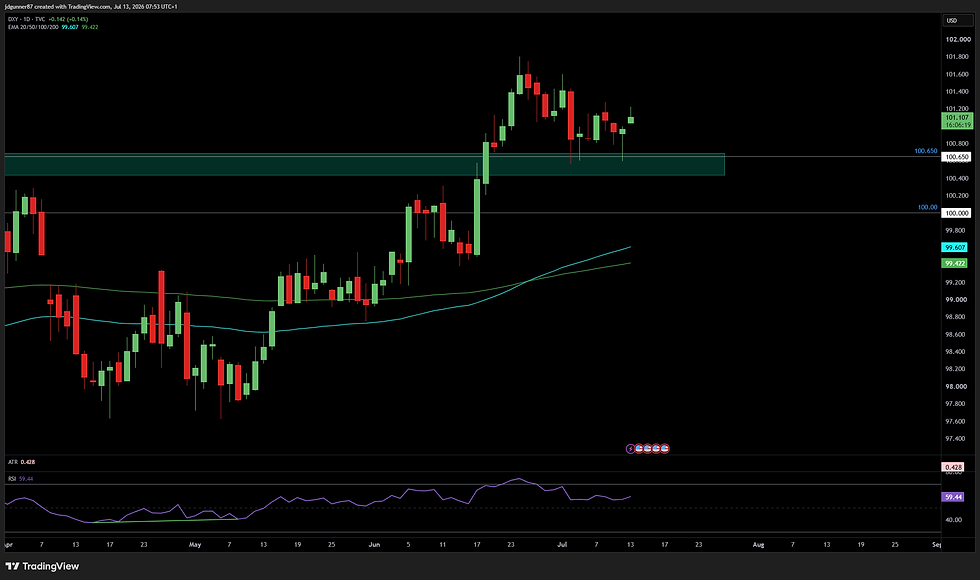
The DXY closed slightly higher on the week, but not as much as we may have expected given the escalation in Iran. The USD is still finding support at the 100.650 DXY level, as rising oil prices are giving back some lost fuel to the rate-hike story.
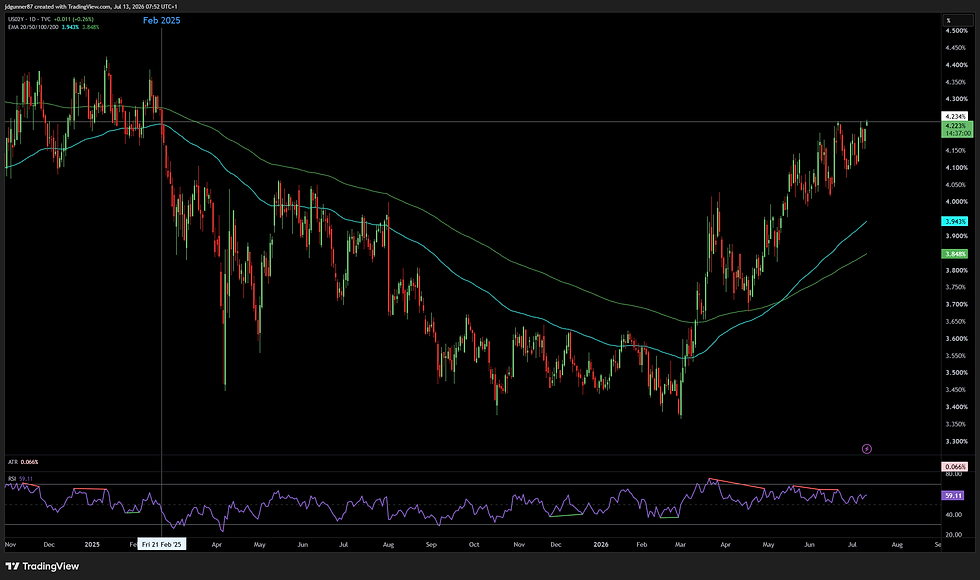
One of the quieter stories of the week, but one of the most important, has been the rise of US yields over the week. The US 2y yield is now back to the highest it has been since Feb 2025, while the 10y yield is up to its highest since May this year and could see its highest close since Jan 2025 if the trend continues. This is telling us markets are expecting rate hikes, with a September rate hike now predicted to be more likely than not. Higher yields could be a key factor to watch as we approach this week's CPI figure and towards the next FOMC meeting later in the month.
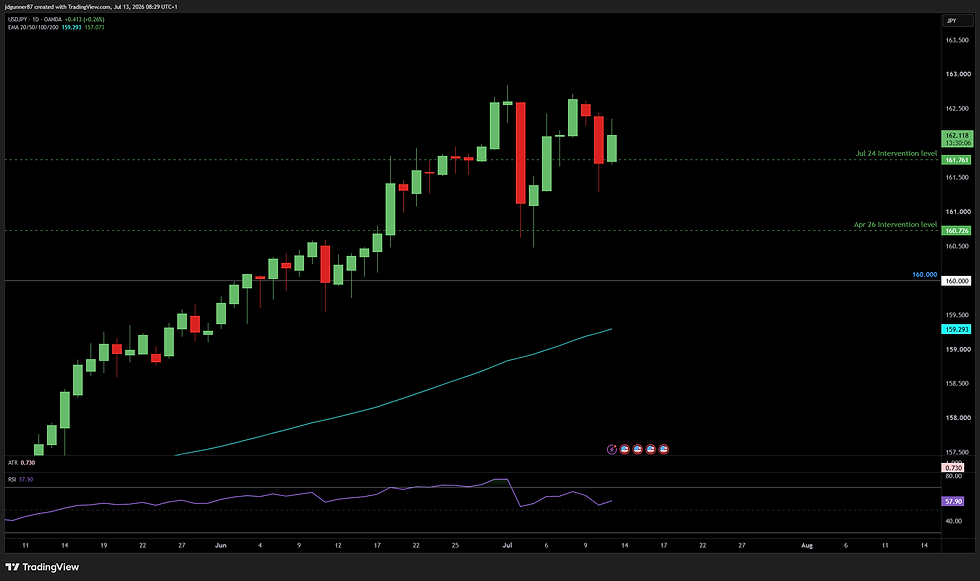
The USD/JPY continues to play games, with seemingly yet another minor intervention on Friday. It did not have too much of an effect, however, as the pair is once again approaching highs after the weekend's events. The Japanese government over the weekend announced that it plans to encourage pension funds to increase holdings of domestic financial assets, which could help keep the pair under control without the need for BoJ interventions. However, should we see a longer-term resumption of hostilities in Iran, this may not be enough to stop the seemingly inevitable move higher in the pair. The next great hope for the BoJ will be the CPI print tomorrow; they will be praying for a soft print to give the USD/JPY pair some more room to breathe.
CAD continues to see some support from rising oil prices, with its continued exposure to oil. The next few days of talks could be hugely important for the currency. In the longer term, once a final resolution has been found for the region, the CAD's dependency on oil should lessen a little, but for the time being, a CAD long trade is effectively a proxy for an oil long trade.
AUD and NZD have struggled this morning as the markets turned risk-off after the weekend's events, and are still tied to the fate of precious metals that also fell this morning. Towards the end of last week, there were signs that the AUD was decoupling a little from metals, as the risk-on environment gave the AUD some support while pushing down demand for gold. If the tensions in Iran remain escalated, however, we could see the relationship strengthen once again as both are hit by rate hike concerns. The AUD could be an interesting watch over the next few weeks.
The EUR and GBP remained steady, with the GBP still outperforming the EUR thanks to the removal of political uncertainty in the UK and some healthy recent fundamental data.
Indices
Friday was another day that went against the recent growth-to-value swing that we have discussed over the past few weeks. Last week overall saw the Nasdaq gain over 1%, the S&P gain over 1%, but the Dow fell 0.5%.
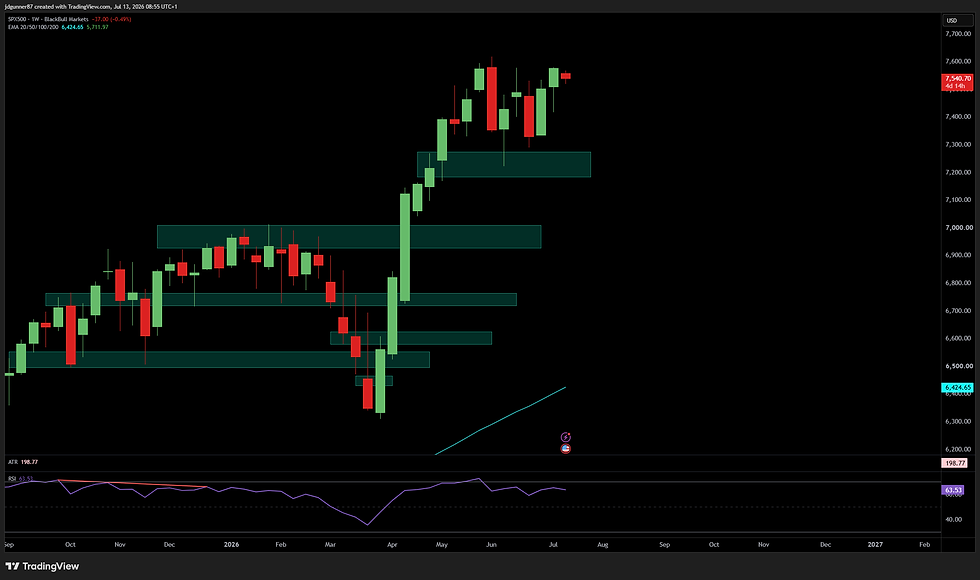
We had been discussing the slow deflation of the AI/tech stock balloon that was being shown with the Dow outperforming the S&P and Nasdaq. Last week's price action has gone against this. The question now is, was the 'deflation' a temporary rest before AI and tech boom again, or was this week a late-cycle final push for oversold assets before a more sustained fall in tech stocks plays out? The push last week for growth stocks was led by a small number of mega-tech stocks, with the Russell 2000 falling by 0.8% last week, some proof of this. The narrow-leadership problem is still evident, meaning all it would take is for these few companies to see pullbacks, and we would see the market as a whole suffer. The balloon deflation thesis may not be dead; it may just be taking a breath.
This week we are back into earnings season and have the crucial CPI print tomorrow. Investors in the mega-cap stocks will be expecting nothing but blowout results for earnings, so any sort of disappointment coupled with a hot CPI print could cause last week's gains to be wiped out and then some. This week will be very important for the indices and could be very volatile. The potential is there to win big if you call the direction, but also to lose big if you get it wrong. This week, as much as ever, is one where risk needs to be managed carefully.
Precious Metals
Friday saw some noise in the metals markets, but ultimately no real movement either way; neither Gold nor Silver closed more than 0.5% away from their open. Both have gapped lower this morning, however, due to the increased oil prices and rate-hike risks over the weekend. The same situation will play out as it did during the previous phases of the war: the rate-hike channel will completely overpower the safe-haven demand for metals, with both tomorrow's CPI print and news from Iran being the main catalysts for the week. If we do not see any surprise news or unexpectedly dovish data releases, I would expect to see metals continue to struggle this week. However, as with forex and indices, this week has so many unknowns and potential surprises that predicting a direction is very difficult. This may be a week to stay on the sidelines until the market has made up its mind on a direction.

This Week's Market Drivers
US CPI, Tue 1:30pm UK time - This will be the most important single data release of the week and possibly the month. An unexpected figure will cause huge moves in the market and will have significant implications on FOMC policy moving forward.
US PPI, Wed 1:30pm UK time - Another inflation metric from the US, this will also have an effect on markets overall and will be a keen one to keep an eye on.
Fed Chair Warsh Testifies, Tue & Wed, 3pm UK time - Warsh will testify in front of Congress this week. There seems to be a likelihood that he stays as vague as he did with his FOMC press conference, but nonetheless, any dovish or hawkish language will be pored over by markets.
Iran Negotiations - Updates on the Iranian situation will also have a huge effect on markets. Further escalation or reports of progress in negotiations will have an effect on all markets.
Oil Prices - Heavily linked, of course, to the Iranian situation, oil prices rising or falling will have a knock-on effect on almost everything else in one direction or the other.
BOC Rate Statement, Wed 2:45pm UK time - This will have a significant effect on the CAD and could be a guide to possible rate decisions and guidance for other central banks later in the month.
GBP GDP release, Thu 7:00am UK time - The latest economic release from the UK, this could either reinforce the growing optimism around the UK or burst the bubble.
Comments